https://eskesthai.net/2026/09/05/geometry-of-memory/
Before the line, there was the point;
before the journey, relation woke.
We drew the world in lines so straight,
and thought its form was fixed by fate.
Then came the question, sharp and bright:
What if the line could bend in flight?
What if space, beneath the scene,
was not a stage, but lived between?
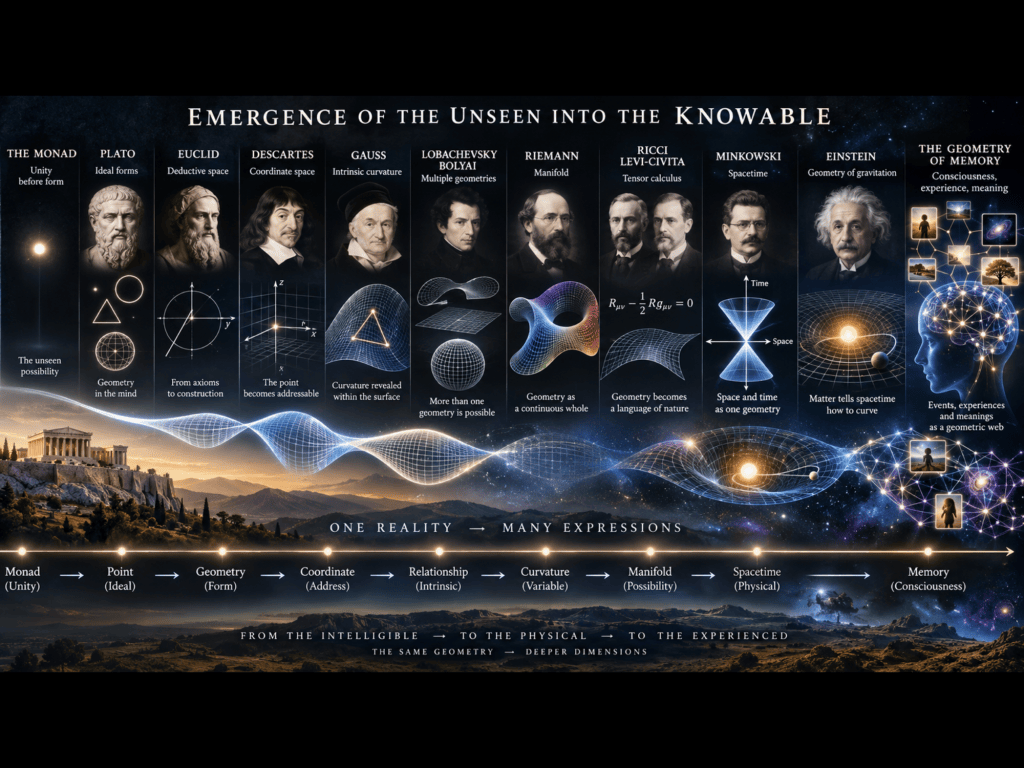
Euclid gave memory its frame;
Gauss found curves no ruler could name.
Lobachevsky and Bolyai
let parallel lines divide the sky.
Riemann asked what space might be;
Einstein heard geometry.
Matter curved the darkened night,
while spacetime guided every flight.
The path replied through dark and light:
“Move here. Turn there. Become by right.”
So now we enter memory’s sphere,
where distant things may still draw near.
A childhood room, though years away,
may stand beside us here today.
A scent can shorten decades gone;
a song can bring the old light on.
A voice, a hand, a floor, a door
can open time we thought was gone.
We do not store the world entire,
like ash preserved from an old fire.
We place one thing by one thing’s side:
the face, the voice, the room, the tide.
A single word can mark a track
and lead through years to bring us back.
A wound may form a hollowed ground
where later memories circle round.
One act of understanding’s light
can bring far moments into sight.
Memory is no chain of days,
but shifting roads and changing ways.
Each new experience redraws
the distances of what once was.
The past remains, yet changes place
within the mind’s remembering space.
Two separate moments meet as one,
revealing paths their lives have spun.
Thus memory is not behind;
it is the space within the mind.
What has occurred remains alive
through all the selves we still derive.
The past is measured once again
by who we are and where we’ve been.
The future waits beyond the chart,
an open field, an unmade part.
Point to line, and line to plane;
plane to form, and form to frame.
Form to world, and world to mind;
mind to memory’s design.
Memory to consciousness,
which reads the map and travels thus.
What once was hidden becomes relation;
what joins becomes interpretation.
We do not carry memory’s stone,
as though the past were weight alone.
We carry coordinates instead:
the place, the face, the words once said.
The distance and the turning sign,
the path by which the lost may shine.
From these, the vanished may return—
not whole, but bright enough to learn.
The point remembers circle’s round;
the circle holds the sphere profound.
The sphere returns the point once more,
but now through space with widened door.
And consciousness, between the years,
between the hopes and former fears,
draws a line through dark and dawn,
across the ground that time has drawn.
Not through emptiness, not alone,
but over all the paths we’ve known.
The unseen rises, clear and bright;
the known becomes a guiding light.
Memory gathers form and frame;
structure becomes the path we name.
And on that path, through time and weather,
we learn to bring ourselves together.
We remember, step by step,
the selves we were, the selves we’ve kept.
We remember, through the strife,
the geometry of life.
Each line we draw anew
lets past and future travel through.
The point becomes the path we see;
the path becomes what we may be.
And into time, through shadowed skies,
we remember ourselves to rise.