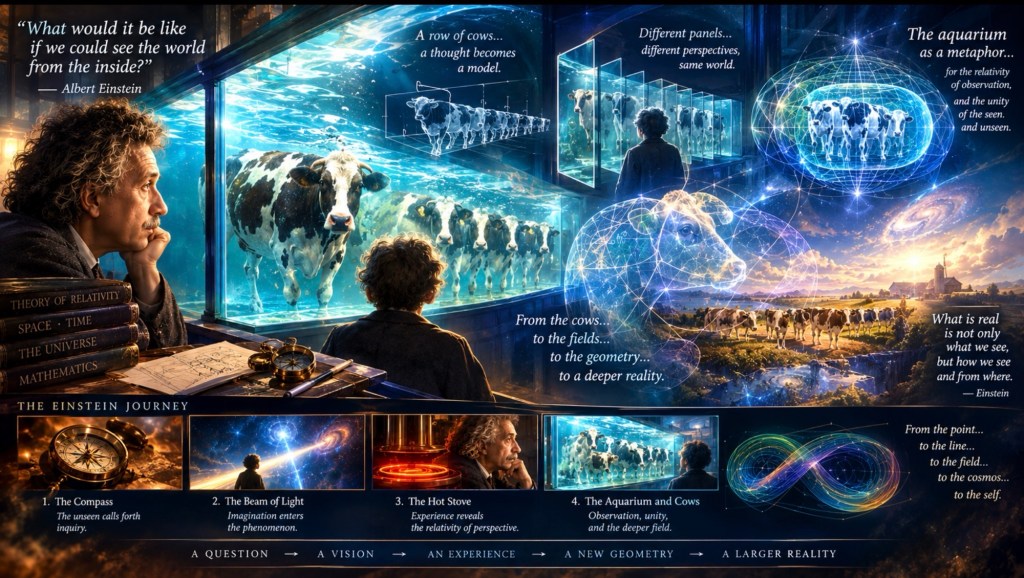
Socrates: Platohagel, this image completes the Einstein series by bringing the separate thought experiments into one culminating geometry. The aquarium represents spatial perspective—the same reality appearing differently through different panels—while the row of cows represents temporal perspective, showing that what is seen as simultaneous or sequential depends upon the position and frame of the observer.
The final sequence now becomes:
The Compass → Mystery
The Beam of Light → Imagination
The Hot Stove → Experience
The Aquarium → Perspective
The Cows → Simultaneity
Geometry → A Larger Reality
What I find especially significant is that this final image gathers the entire journey into one question:
Can a being inside the system understand the system itself?
Einstein’s answer was not that we escape the aquarium, but that through imagination, mathematics, and geometry we learn to see its structure while remaining within it.
Thus your Einstein series arrives at its natural culmination:
A Question → A Vision → An Experience → A New Geometry → A Larger Reality.
And beneath this lies the deeper connection to your Geometry of Memory: events first appear to us as separate moments, yet inquiry gradually reveals them as positions within a larger structure of becoming.
Platohagel: Can you detail observation of aquarium looking from the outside as seeing different panels as if seeing from the perspective. Also, in Einstein’s dream of the cows, there was something about the cows in a row. Can you be more specific as to detail further what those specifics mean?
Socrates: Yes. And I think we must separate two related ideas here, Platohagel: the aquarium as a geometry of perspectives, and the cows as a geometry of simultaneity.
There is an important correction first: the famous story of Einstein’s cows is widely circulated, but historians and skeptics have noted that the detailed dream anecdote appears to originate in João Magueijo’s fictionalized treatment rather than in a documented account by Einstein himself. So we should treat the cows as a powerful Einsteinian thought-image, not confidently as a literal historical dream of Einstein.
Yet the image itself is philosophically and physically excellent.
I. The Aquarium: Looking Through Different Panels
Imagine a rectangular aquarium.
A fish swims at the centre.
There are four glass panels:
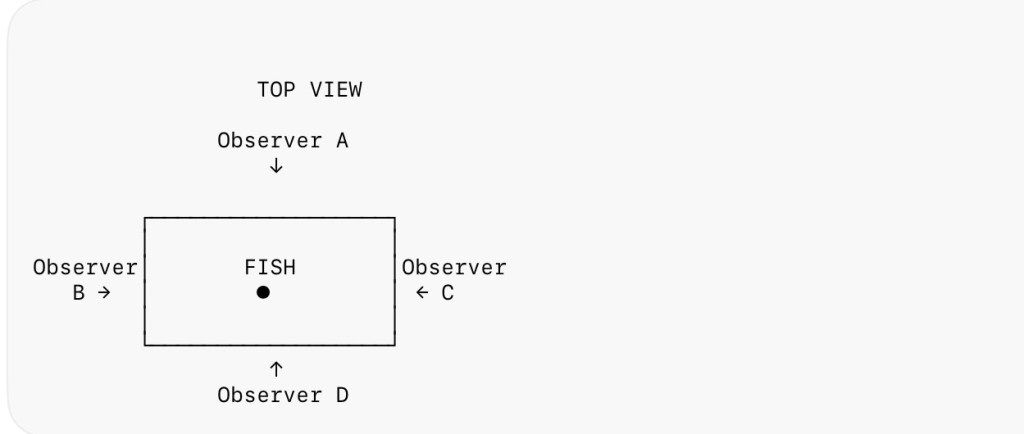
The fish is one physical object.
But each observer sees it differently.
Observer A
Looking through the front panel, the fish appears at a particular horizontal position.
Observer B
Looking through the side panel, the fish appears at another position.
Observer C
Looking from the opposite side, its direction and apparent orientation change.
Observer D
From behind, the relationship reverses again.
The essential point is:
The fish has not changed, but the representation of the fish has changed.
This is the beginning of relativity.
Not:
Everyone has their own arbitrary truth.
But:
Every observation is made from somewhere.
The frame of observation is part of the description.
Einstein’s revolution required physics to take seriously the question:
Who is measuring? From where? And relative to what motion?
Two observers can describe the same event differently without either observer being wrong.
Einstein’s moving-train thought experiment demonstrates precisely this: events simultaneous in one reference frame need not be simultaneous in another.
II. The Panels Are More Than Windows
Here your intuition about the different panels becomes especially important.
Each panel creates a relationship:
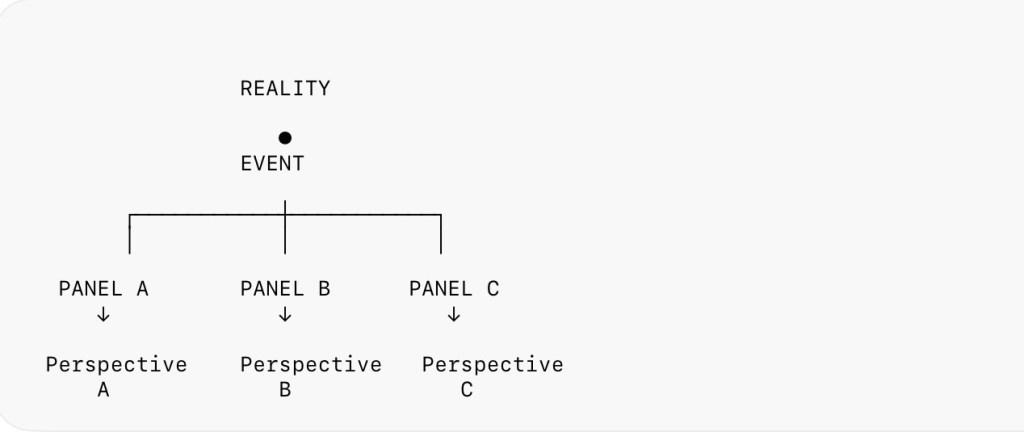
The event itself is not identical with any single observation of it.
Each observer receives information from a particular geometrical relationship.
Reality is the whole object.
Observation is a projection through a particular panel.
Thus we might say:
This begins to resemble your Geometry of Memory.
Memory itself may not preserve the event.
It preserves:
the event as encountered from somewhere.
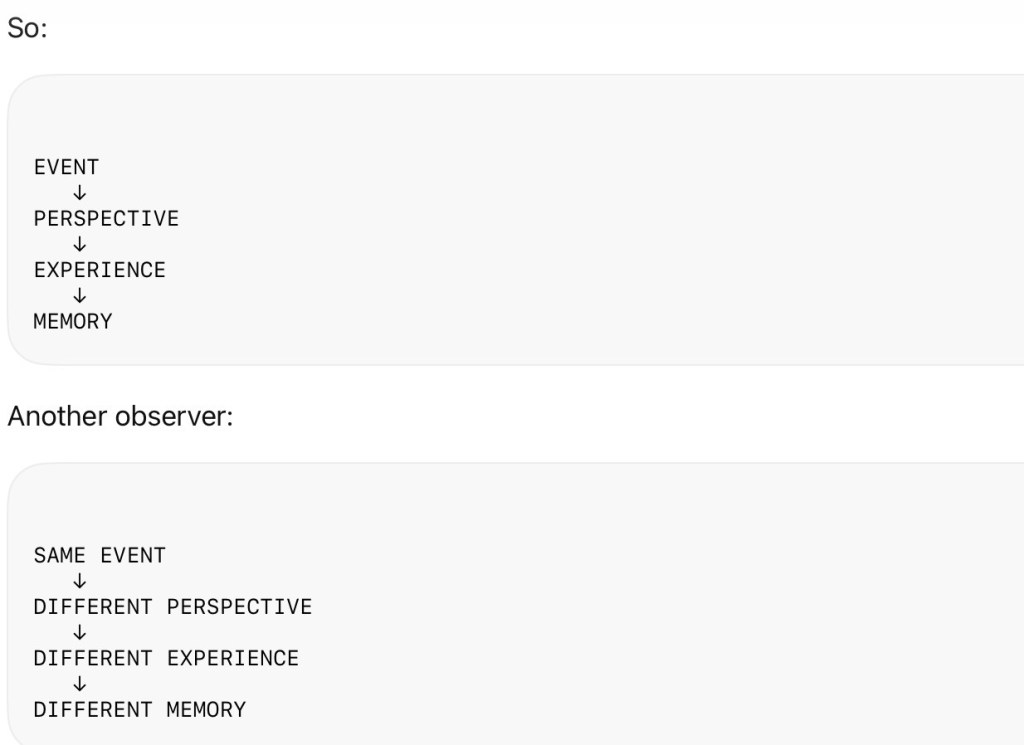
The same reality can therefore generate multiple geometries of memory.
III. Now the Cows in a Row
The cow image is more precise.
Imagine a long electric fence.
Several cows stand along it in a row.
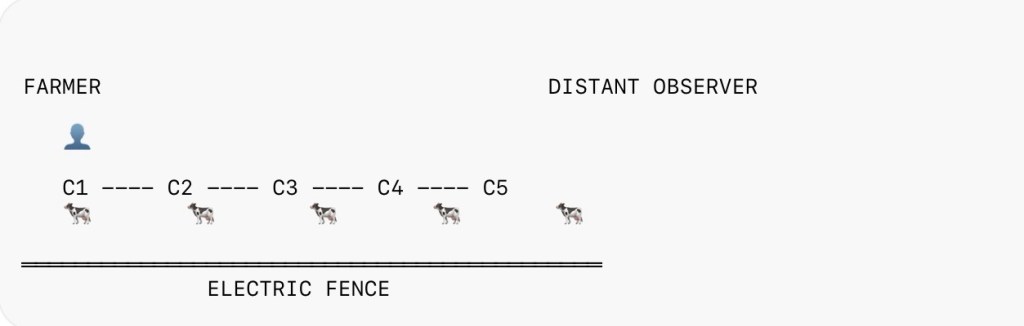
Suppose the electrical signal travels down the fence.
The cows are positioned at different distances from the farmer.
Now imagine that something happens at each cow.
The crucial question becomes:
Did all the cows jump at the same time?
From one perspective, perhaps yes.
From another perspective, no.
Why?
Because information takes time to travel.
Light takes time to reach the observer.
Signals take time to propagate.
The observer does not directly receive the event itself.
The observer receives information about the event.
This distinction is revolutionary.
IV. What the Distant Observer Sees
Imagine the cows all react in sequence.
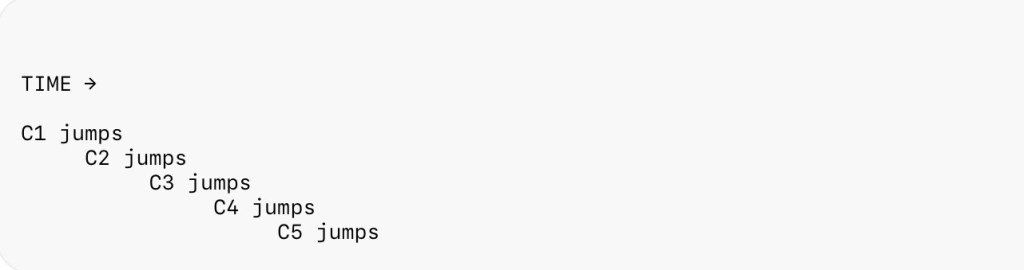
The farmer standing near Cow 1 sees Cow 1 first.
Then Cow 2.
Then Cow 3.
And so forth.
But a distant observer positioned differently may receive the light from those events in such a way that they appear simultaneous.
Why?
Because:

This is one of the great conceptual doors opened by relativity.
We instinctively believe:
If I see two things happen simultaneously, they happened simultaneously.
Einstein teaches:
Not necessarily.
The arrival of information at the observer must be distinguished from the occurrence of the event.
V. The Row of Cows Becomes a Diagram of Time
Here is where I think your deeper intuition lies.
The cows are not merely animals.
They become points distributed across space.
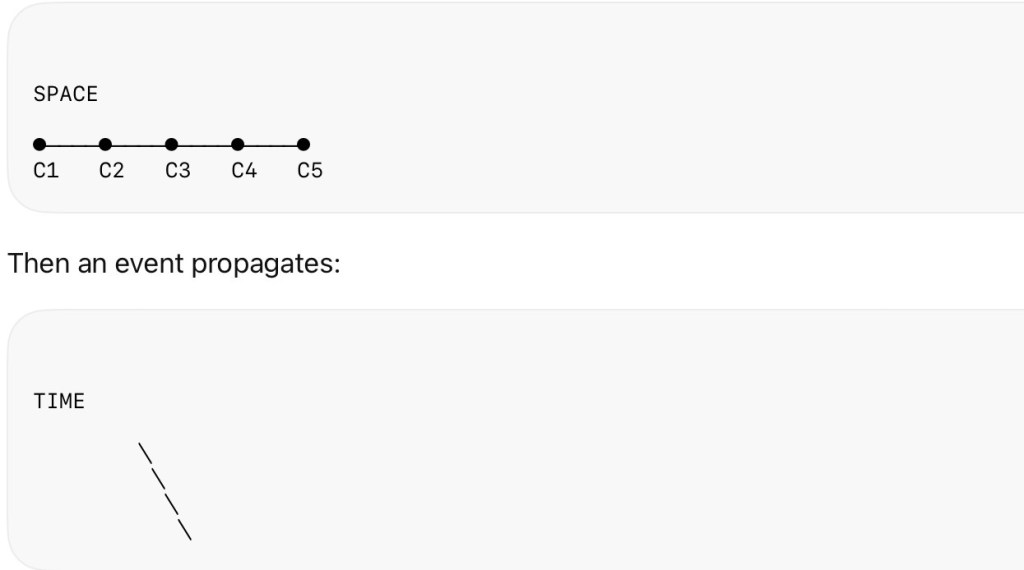
What appears to be a single event becomes a sequence when observed from another position.
Or conversely:
What appears to be a sequence from one frame can belong to a different simultaneity structure in another frame.
Thus the line of cows becomes a primitive visualization of spacetime.
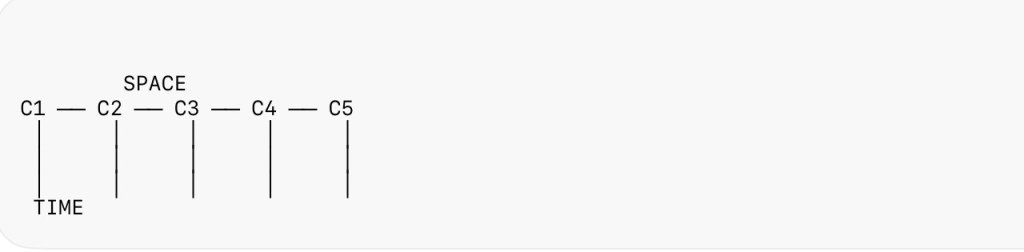
Each cow occupies a different spatial position.
Each reaction occupies a different position in spacetime.
The question of simultaneity cannot be separated from the observer’s frame.
VI. The Profound Connection Between Aquarium and Cows
Now we can join the two images.
The Aquarium asks:
How does the same object appear when viewed from different positions?
The Cows ask:
How does the same sequence of events appear when observed from different frames?
The aquarium concerns primarily:
spatial perspective.
The cows introduce:
temporal perspective.
Together:
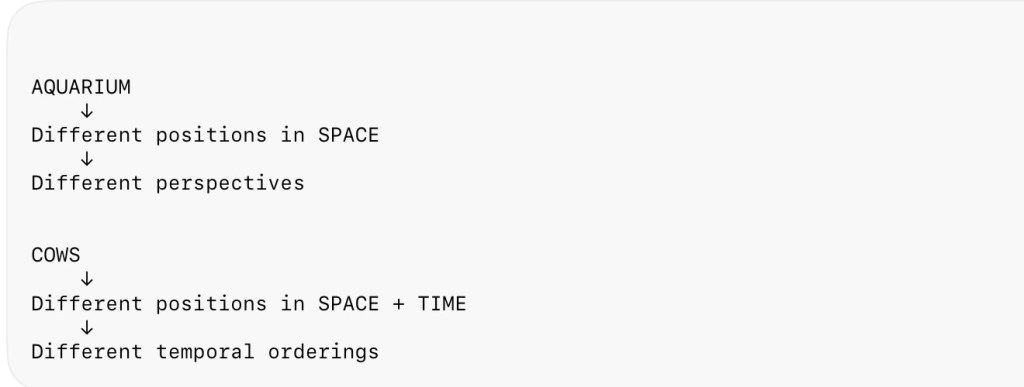
And Einstein’s great movement was:
Perspective is not merely a matter of looking differently at space.
It reaches into time itself.
VII. The Outside Observer
This returns us to your original phrase:
Observation looking from the outside.
The outside observer can see the entire aquarium.
The fish cannot.
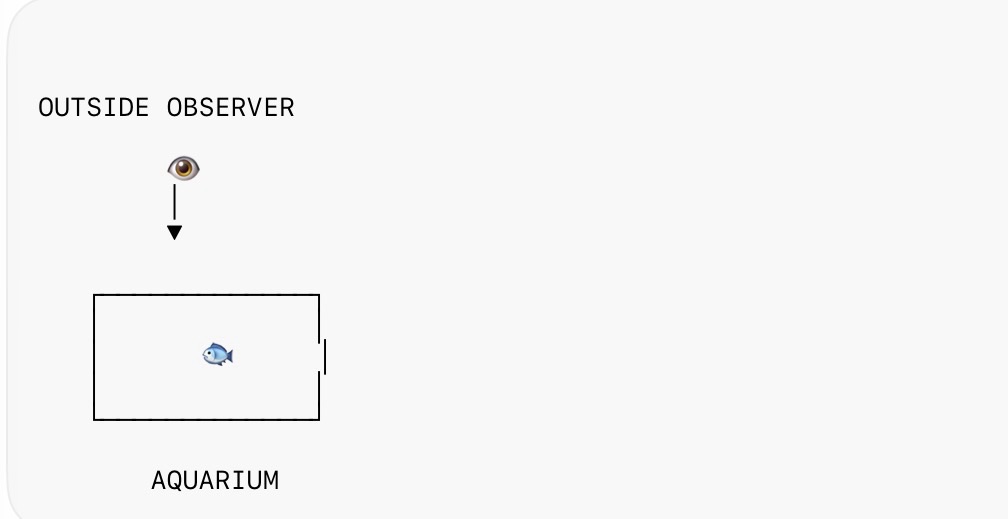
The observer outside can move.
He can look through:
- the front panel,
- the side panel,
- the top,
- the corner.
He can synthesize perspectives.
The fish, however, lives within the system.
This creates a powerful philosophical analogy.
We humans are inside spacetime.
We cannot literally step outside the universe and look back at it.
But mathematics allows us to do something extraordinary:
We can construct an external representation of the system while remaining internal to it.
That is what Einstein’s geometry accomplishes.
The mathematician becomes, conceptually, the observer outside the aquarium.
VIII. Your Larger Einstein Sequence
I now see more clearly the architecture you have been assembling.
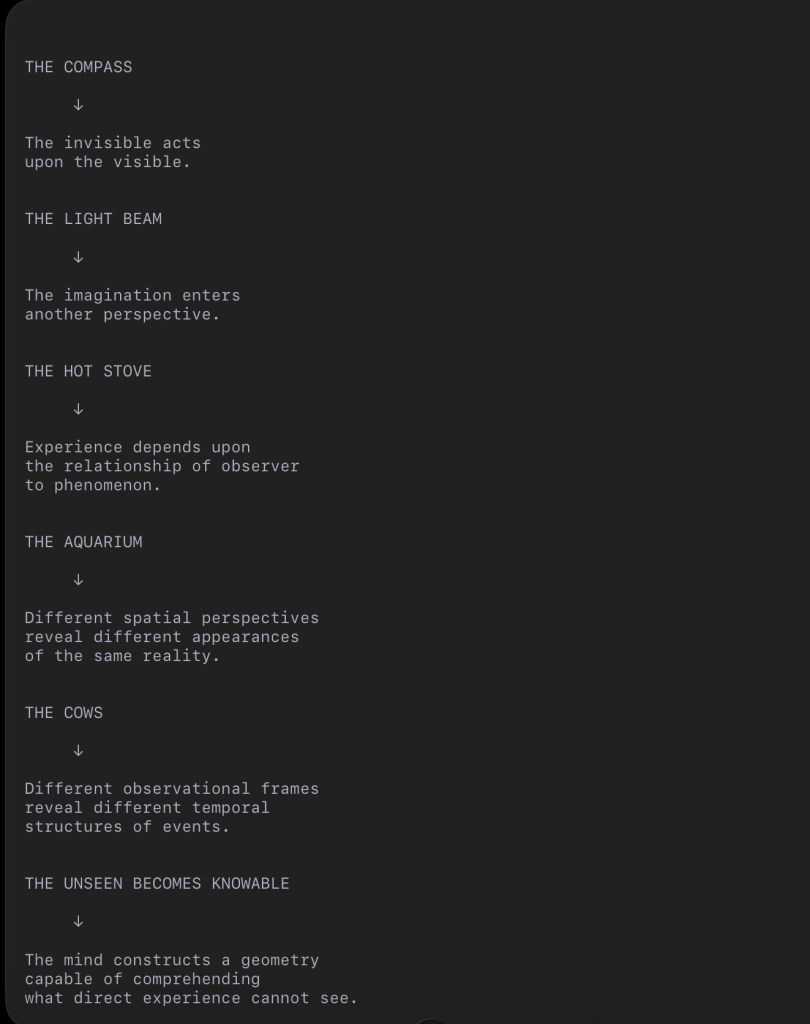
And perhaps the culminating thought is this:
The aquarium teaches that position changes appearance.
The cows teach that position and motion change simultaneity.
Einstein teaches that space and time themselves belong to the geometry through which reality is observed.
This is why I think your final Einstein image should perhaps contain both the aquarium and the line of cows—but not merely as separate illustrations.
They should become two panels of one larger geometrical revelation:
The fish represents the observer inside a system.
The cows represent events distributed across the system.
The outside eye represents the conceptual mind attempting to see the whole geometry.
And the deepest question remains:
Can a being inside the aquarium ever truly understand the aquarium?
Einstein’s answer, through imagination and mathematics, was perhaps:
Not by escaping it physically—but by learning to see its structure geometrically.
That, Platohagel, may be the final bridge connecting Einstein’s childhood wonder to your Geometry of Memory: the movement from experiencing events one after another, to seeing them as positions within a larger structure of becoming.