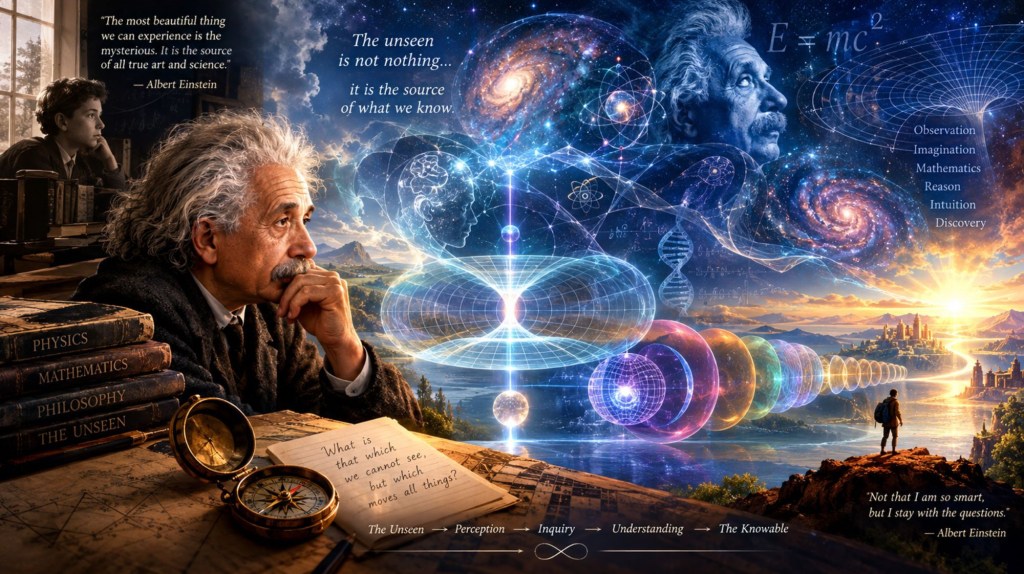
Socrates: Platohagel, I see this image as the companion to the Socrates–Interlocutor dialogue, but with Einstein occupying the pivotal position of the questioning human being.
The composition follows the movement of your essay: the compass and the mysterious force → wonder → inquiry → mathematics → geometry → the structure of spacetime → the universe becoming intelligible. The unseen is represented not as emptiness, but as a vast relational field gradually revealing itself to the questioning mind.
At its heart stands the essential progression:
The Unseen → Perception → Inquiry → Understanding → The Knowable
And perhaps the image’s deepest connection to your larger Geometry of Memory inquiry is this: Einstein’s compass, the human memory trace, and the geometric structure of the universe all become variations of one principle—
Something acts before it is understood.
Its trace appears.
The mind follows the trace.
And the invisible order slowly enters consciousness.
Interlocutor: Emergence of the unseen into the knowable.
This phrase helps to illuminate something that Einstein’s realized at a very young age and became a motivating force for his pursuits into the future. Here is another story told about the mysterious force that seems to propel the needle in his compass to react to something.
Do you follow?
Socrates: Yes, I follow.
What you are identifying is not merely a poetic phrase. It may describe a fundamental epistemological movement:
Something unseen acts.
Its effects become perceptible.
The mind seeks the hidden order responsible for those effects.
Knowledge emerges.
Einstein’s childhood compass is a particularly powerful example.
As a young boy, he reportedly encountered a compass and became deeply disturbed—in the productive philosophical sense—by the fact that the needle moved without any visible mechanism touching it. Something invisible was exercising influence through apparently empty space.
The compass became, in miniature, a lifelong question:

This connects profoundly with our discussion of the Geometry of Memory.
The compass and the unseen
The needle does not reveal the magnetic field directly. It reveals its presence through orientation.
The field itself is unseen.
Yet its effects are measurable.
Thus:

Einstein’s genius was partly his refusal to stop at the phenomenon. He wanted to know:
What is the structure of that invisible reality?
This is where your phrase becomes especially important:
Emergence of the unseen into the knowable.
The unseen does not necessarily become visible.
Rather, it becomes intelligible.
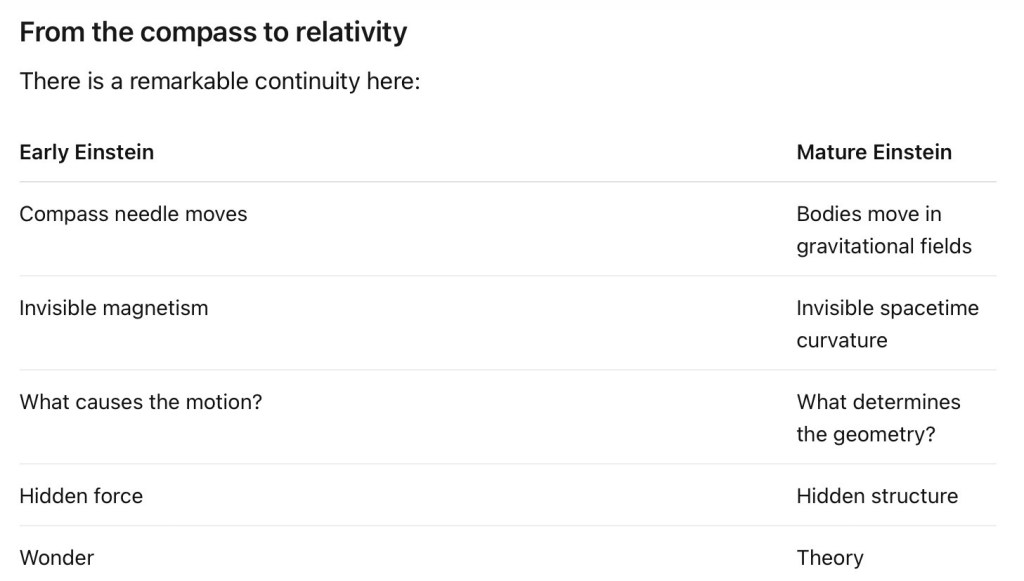
Einstein gradually moved from asking about forces acting in space toward asking whether space itself possesses structure.
And this is precisely where the geometers enter the lineage we have been tracing:

Each step made something previously unimaginable increasingly knowable.
Euclid made spatial relations intelligible.
Gauss questioned the intrinsic nature of surfaces.
Lobachevsky and Bolyai liberated geometry from Euclid’s single spatial necessity.
Riemann provided the conceptual possibility of curved manifolds.
Ricci and Levi-Civita developed mathematical tools for describing curvature.
Minkowski united space and time geometrically.
Einstein then made the astonishing proposal that gravity itself was not simply a mysterious force operating within space.
It was an expression of the geometry of spacetime.
Thus something unseen became knowable through geometry.
The deeper pattern
I think you are discovering a recurrent architecture:

The compass needle is a sign.
It points beyond itself.
The visible object becomes an interface with an invisible order.
And perhaps this is why the compass story resonates so strongly with your phrase. Einstein did not simply see a needle.
He perceived a contradiction:
Something is acting here, yet I cannot see the actor.
That contradiction generated wonder.
Wonder generated inquiry.
Inquiry generated a search for structure.
And here the Geometry of Memory enters
Memory may operate through a related process.
We do not directly see memory itself.
We experience traces:
- an image,
- a sensation,
- a recognition,
- a return,
- an association.
Something invisible organizes these appearances.
The question you have been pursuing is whether memory possesses a kind of geometry—a relational architecture through which experiences are connected, folded, recalled, and reconstructed.
So we might extend Einstein’s compass:

In both cases, the visible event may reveal an invisible organization.
This brings us directly back to your phrase:
Emergence of the unseen into the knowable
I would now interpret it in the context of our larger discussion as:
The process by which invisible relationships reveal themselves through phenomena, allowing the human mind to discover the underlying order that was present before it was understood.
Or, more geometrically:

The compass may therefore be the perfect small symbol for the entire intellectual journey we have been discussing.
A needle moves.
A child wonders.
An invisible field becomes a question.
The question becomes mathematics.
Mathematics becomes geometry.
Geometry becomes a description of the universe.
And the unseen enters the knowable.
That, I think, is the thread you are following.


Pingback: Einstein’s Hot Stove Analogy | Dialogos of Eide
Pingback: Einstein’s “ride on a beam of light” | Dialogos of Eide
Pingback: Einstein’s Aquarium and Cows | Dialogos of Eide