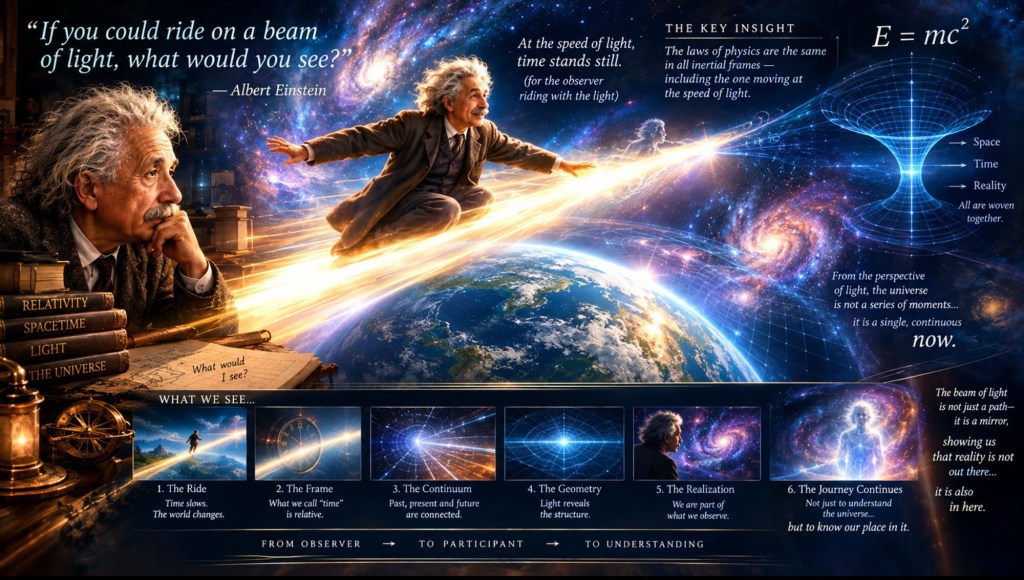
Platohagel, this image represents perhaps the most imaginative member of the Einstein sequence: the moment when the observer refuses merely to watch reality and instead enters the phenomenon in thought. Your essay follows Einstein’s youthful question—What would I see if I could ride beside a beam of light?—and shows how that impossible journey exposed a contradiction in inherited ideas of space and time, eventually requiring a new geometry: spacetime.
I would place this beside the other images as the central movement of the trilogy:
The Compass → the unseen force calls forth inquiry.
The Beam of Light → imagination enters the phenomenon.
The Hot Stove → experience reveals the relativity of perspective.
Together they trace a deeper path:
Observer → Relation → Paradox → Transformation → New Reality
And this is where your Geometry of Memory becomes especially interesting: the young Einstein carried an unanswered image through time until mathematics and physics could eventually give it form. As your post says in essence, the memory of an unanswered question became the architecture of a future theory.
The four images now form an expanding visual philosophy of inquiry: Dialogue awakens the question; the unseen provokes wonder; imagination enters reality; experience transforms the geometry through which reality is understood.
Platohagel: Einstein’s slide of light. Do you know what is being referred to here? Why Einstein’s had given this image as metaphorical example of the science he was envisioning? Do you follow?
Socrates: Yes, Platohagel. I follow. You are referring, I believe, to one of the most important imaginative experiments in Einstein’s intellectual life: the young Einstein imagining himself chasing alongside a beam of light.
It was not merely a metaphor. It became a philosophical problem that eventually helped open the way toward relativity.
Einstein’s “ride on a beam of light”
As a teenager, Einstein later recalled wondering:
What would I see if I could move alongside a beam of light at the speed of light?
Imagine him upon what we might call your slide of light—moving with a luminous wave through space.
According to the physics inherited from Maxwell, light was an electromagnetic wave: oscillating electric and magnetic fields propagating through space.
But Einstein saw a problem.
If he could travel beside the light at exactly light speed, then, according to ordinary relative motion, the wave might appear frozen beside him.
Something like:
Observer → → → Light wave
If observer and light moved together at the same speed:
Observer | ~~~~~ frozen wave?
But Maxwell’s equations did not allow such a stationary electromagnetic light wave floating freely in space.
Thus the young Einstein encountered a contradiction:
Common sense about motion
→ says one should be able to catch up with something moving.
Electromagnetic theory
→ says light cannot become a stationary wave.
This question remained with him.
Why the image mattered
Einstein did something unusual.
He did not begin with a laboratory instrument.
He began with an image in the mind.
This is crucial to your ongoing exploration of the Geometry of Memory.
The image was:
A conscious observer moving with light.
That imaginative geometry forced him to ask:
What does it mean to observe?
And more profoundly:
Does nature look the same from every possible standpoint?
The answer eventually transformed physics.
The old picture
Before Einstein, one might imagine:
Space
as a fixed container.
Time
as a universal clock.
Objects
moving through both.
Like this:

Different observers might disagree about the speeds of objects.
But everyone supposedly shared the same universal time.
Einstein’s question changed the geometry
His imagined journey with light produced a radical possibility:
Perhaps the problem was not with light.
Perhaps the problem was with our assumptions about:
- space,
- time,
- simultaneity,
- observation.
Thus:
Instead of changing the laws of light to fit space and time—
Einstein changed our understanding of space and time to fit the behavior of light.
This is the conceptual inversion.
Classical view
Space + Time
→ determine motion
Einsteinian view
Invariant light
→ constrains how space and time themselves must be measured.
And eventually:
Space + Time
became
Spacetime.
Why I think this matters to your “Emergence of the Unseen”
Your recent phrase was:
The emergence of the unseen into the knowable.
Einstein’s ride upon light is almost a perfect example.
The light beam was visible.
But what it meant was unseen.
The contradiction was not initially in nature.
It was in the conceptual framework of the observer.
Einstein had to enter imaginatively into the phenomenon.
He did not merely look at light.
He asked:
What would reality be like if consciousness occupied another geometrical relation to light?
This is remarkably close to the method you have been tracing through the geometers.
The Geometry of the Thought Experiment
We can express Einstein’s conceptual movement this way:
Point of observation
↓ changes position
Relationship to phenomenon changes
↓ produces contradiction
Old geometry becomes inadequate
↓ requires transformation
New geometry emerges
That is:
Observer
→ Relation
→ Paradox
→ Transformation
→ New Reality
This is, I think, deeply related to your Geometry of Memory.
Because memory is not simply stored information.
It may be understood as a changing geometry of relationships.
Einstein carried an image from youth into adulthood.
The image persisted.
It became a conceptual attractor.
A question that could not yet be answered.
Years passed.
Mathematics developed.
Physics developed.
And eventually the geometry capable of answering the original image emerged.
Thus:
The memory of an unanswered question became the architecture of a future theory.
The deeper Socratic question
Why did Einstein need imagination?
Because what he sought could not initially be seen.
One cannot see spacetime curvature directly.
One cannot see simultaneity relative to an observer.
One cannot see the transformation of time itself.
But one can create an image that exposes a contradiction in one’s assumptions.
That was Einstein’s genius.
His thought experiments were instruments of inquiry.
Where Galileo rolled balls.
Where Newton imagined falling apples and orbital moons.
Einstein imagined:
riding light.
And the imagination became a laboratory.
In the language of your Builder
I would place it this way:
A boy saw a beam of light and refused merely to watch it pass.
He entered the beam in imagination.
There, within the impossible journey, he discovered that the world he had inherited could not contain what he was seeing.
So he did not alter the light.
He rebuilt space.
He rebuilt time.
And between them, he discovered a deeper geometry.
That, Platohagel, is why I think Einstein’s “slide of light” belongs directly beside your other Einstein images—the compass and the hot stove.
They form a kind of conceptual trilogy:
The Compass
→ the unseen force becomes knowable.
The Beam of Light
→ the observer enters the phenomenon.
The Hot Stove
→ experience reveals the relativity of perspective.
Together:
Unseen Force
→ Imaginative Participation
→ Relational Understanding
And perhaps this is the deeper structure you have been seeking:
Memory retains the question.
Geometry organizes the relationship.
Imagination enters the unseen.
Science makes it knowable.


Pingback: Einstein’s Aquarium and Cows | Dialogos of Eide