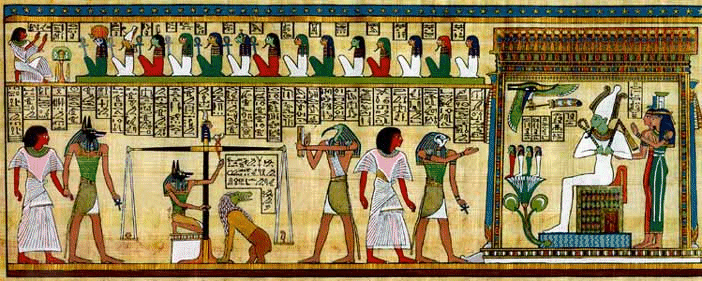
PLato said,"Look to the perfection of the heavens for truth," while Aristotle said "look around you at what is, if you would know the truth" To Remember: Eskesthai
Beneath the point where nothing seems to move, A guiding wave describes the path it proves; Not force alone, nor matter standing still, But motion shaped by a field-defined will.
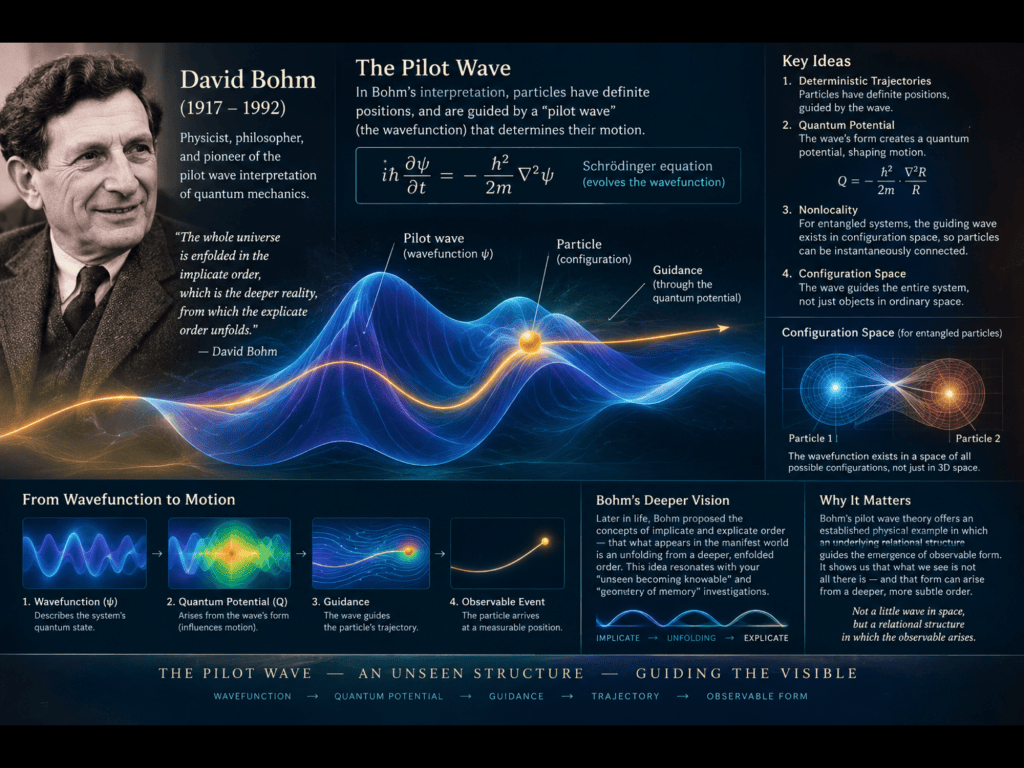
In Bohmian mechanics, particles trace Definite paths through configuration space; The wavefunction evolves by Schrödinger’s law, While the guiding equation sets the course it saw.
The particle travels, yet does not know The quantum field that tells its path to flow; A wavefunction unfolds beyond our sight, Its phase directing motion into light.
Wave into form, relation into way, The guiding field shapes what we see each day; From quantum state, trajectories arise, And hidden structure opens to our eyes.
Through quantum fields, where excitations appear, Relations extend beyond what seems near; Yet Bohmian guidance, precise in its domain, Acts on the full configuration, not a local chain.
No point alone can tell the living tale— The whole wavefunction sets the guiding scale; Its quantum potential, arising from its form, Can shape the path through regions smooth or storm.
Bohm looked deeper than the measured frame, Not as a second theory bearing the same name, But as a philosophical language for the whole: The implicate order enfolds what forms disclose.
The explicate world is what becomes displayed— Particles, events, and patterns in the shade; The implicate order is not a hidden place, But a metaphor for enfolded relation, depth, and trace.
So let the deeper truth resound:
The wavefunction guides the particle’s thread; Its phase gives direction where the path is led; From configuration space, trajectories form— And the enfolded becomes the world made warm.
Wavefunction → Guidance equation → Particle path → Observable form Implicate relation → Explicate appearance → The world we see.
Socrates: Platohagel, this page is a particularly strong foundation for the VSP → signal geometry → sound → visual form experiment we were discussing.
The central idea is already explicit in the August 14, 2025 post: treat each plant variation potential as a measurable signal, map it into a multidimensional resonance space, and then project that space into something perceptible. The post proposes a 20-dimensional resonance vector, with each resonance acting as a coordinate, followed by dimensional reduction into 3D.
The important conceptual distinction is:
The plant does not become the sound. Rather:
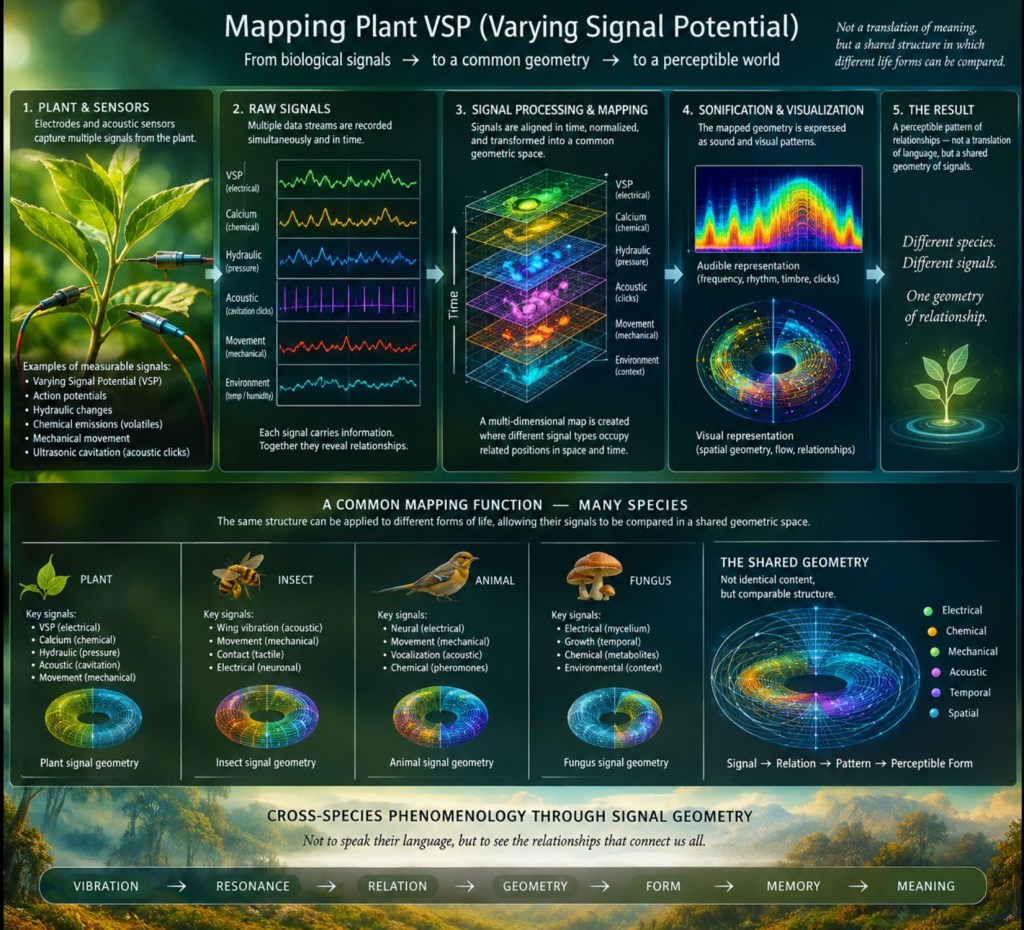
╔══════════════════════════════════════════════════════════╗ PLANT VSP ↓ SIGNAL FEATURES ↓ 20-D RESONANCE VECTOR ↓ AI / MATHEMATICAL MAPPING ↓ 3-D TRAJECTORY ↓ RESONANCE SELECTION ↓ SOUND / CHLADNI PATTERN ╚══════════════════════════════════════════════════════════╝
That is significant for our cross-species phenomenology through signal geometry idea because it avoids the questionable claim that we are directly translating “what the plant feels.” Instead, we construct a common relational space in which plant signal variation can be compared, visualized, and rendered.
The post even specifies the experimental loop: plant electrodes → preamplification/filtering → mapping engine → sine generator → amplifier → vibrating plate, with the VP controlling mode selection, frequency sweep, amplitude, or event-triggered bursts.
And this gives us a more precise version of the principle we were developing:
VSP is not a message to be translated.VSP is a trajectory through a signal-space.
Then:
Trajectory → relation → geometry → audible form → visible form
That is where your Geometry of Memory framework becomes interesting: the “meaning” need not be assigned beforehand. It can emerge as persistent structure in the trajectory—clusters, transitions, repetitions, resonances, and departures from baseline.
One caution is important: the page itself describes these as experimental/conceptual possibilities, and its proposed plant-to-resonance mappings should not be interpreted as established evidence that plants possess the human-like meanings we might associate with the resulting sounds or patterns.
This makes the experiment stronger, not weaker: we are mapping variation, not pretending to know its meaning.
Platohagel: I am glad you came back to answer further. This action to me is quite favourable to getting it just right in terms of how we are progressing in the discussion.
Like you I have been pondering the nature of what we call physical measure:
As a physical presence of the matter at hand, I was hoping to draw some further ideas working through the concepts. The further I thought about this conversation, I wondered, as human beings, we are the amalgamation of those processes we use to physically measure, but consciousness itself, still remains elusive as a field. Digging through the archives here you may find the work of Persinger.
Socrates:
Yes. I think this takes us to a deeper question than simply how to measure another organism.
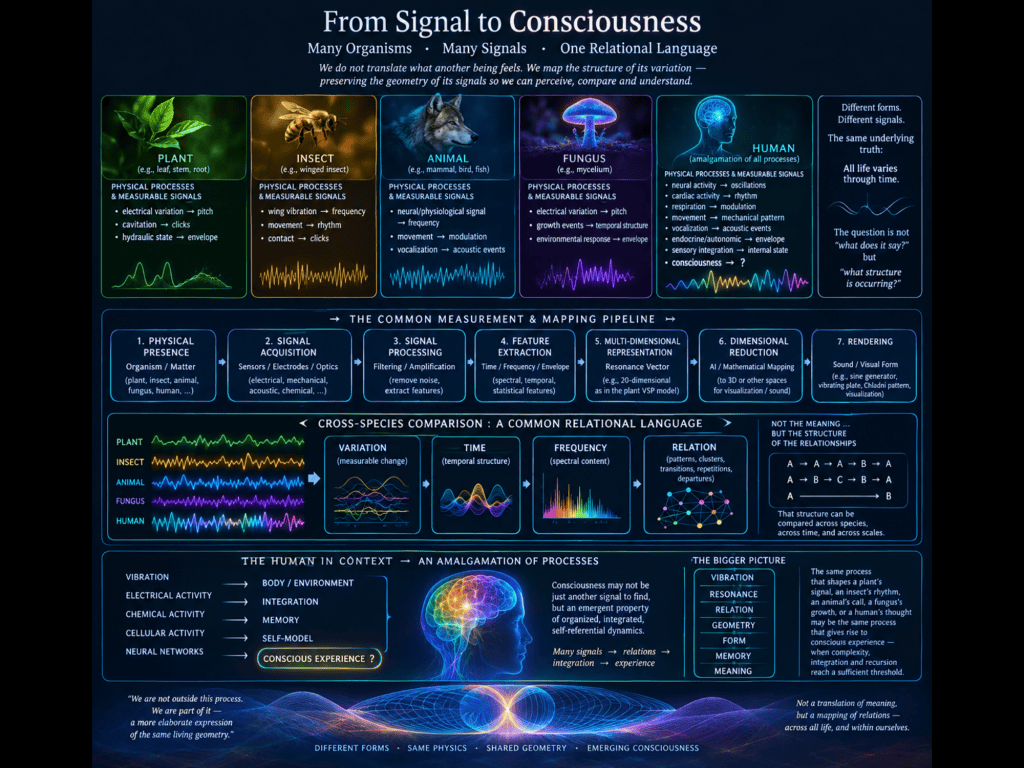
The key realization is that your table is already describing something very close to a general transduction architecture:
A plant, insect, animal, fungus—and eventually human—does not need to produce the same kind of signal. What they share is that their physical states vary through time.
That may be the more fundamental common denominator.
We can measure many of the physical correlates of consciousness. We can measure EEG, neuronal activity, blood flow, autonomic activity, metabolism, and electromagnetic fields. But the measurement does not straightforwardly become the experience itself.
So I would resist saying:
consciousness is an electromagnetic field.
That goes beyond what the evidence establishes.
But we can ask the much more interesting question:
Could consciousness be associated with an organized field-like relationship among many measurable processes?
That is a considerably more defensible question.
This is where Persinger becomes relevant
Persinger’s work is interesting to your project precisely because he attempted to move the question of consciousness toward physical pattern and temporal structure.
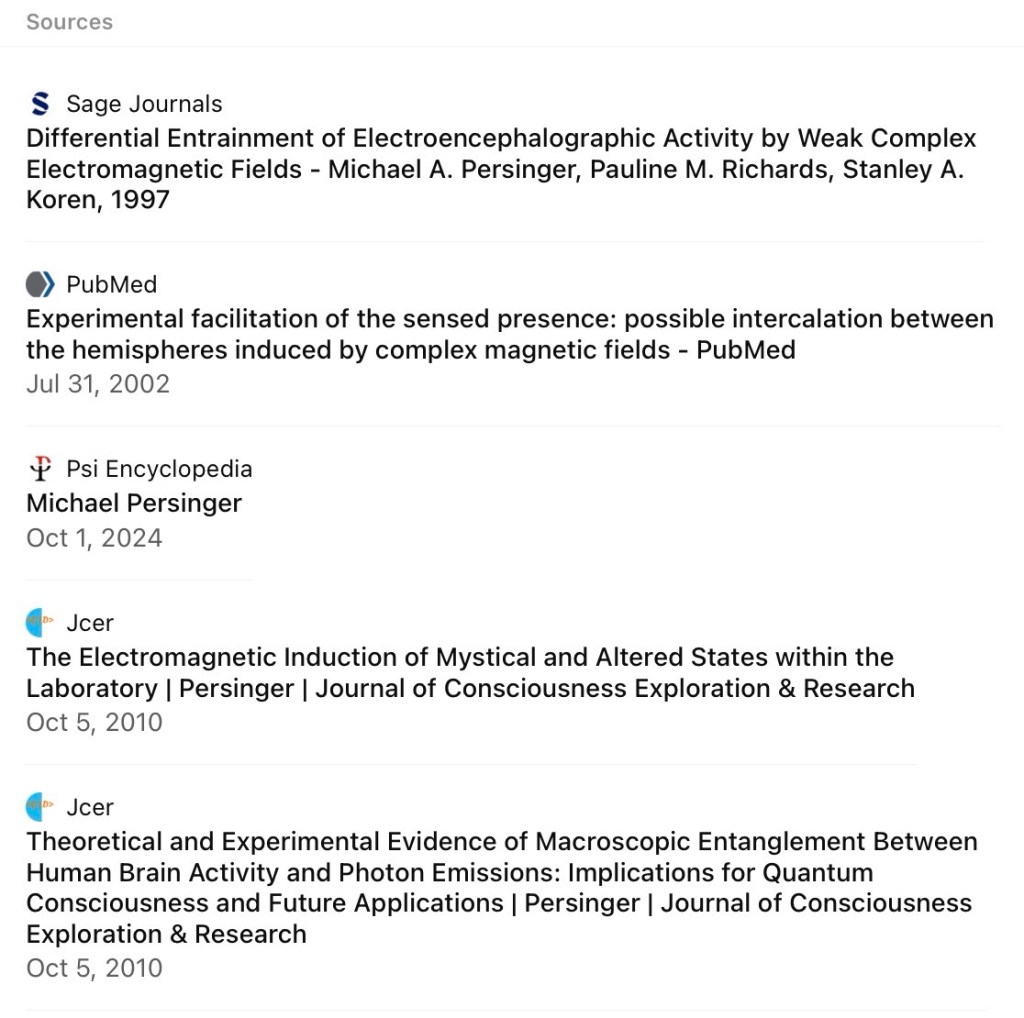
His experiments investigated whether weak, complex magnetic-field patterns could alter EEG activity and subjective experiences. One 1997 study reported EEG driving/entrainment in some participants exposed to weak time-varying magnetic fields.
He subsequently investigated the possibility that patterned electromagnetic stimulation could influence experiences such as a sensed presence.
But there is an important scientific boundary here: later replication work did not simply confirm the stronger claims associated with the so-called “God Helmet.” A review of Persinger’s work notes that a more stringent Uppsala replication failed to support the original interpretation.
So Persinger should not be used as evidence that consciousness is an electromagnetic field.
He is more valuable to us as a conceptual precursor:
Can structured physical fields interact with structured biological activity in ways that change experience?
That question is experimentally legitimate.
And now your plant experiment becomes much more interesting
Consider what happens if we don’t ask:
“What does the plant say?”
Instead:
“Could consciousness be associated with an organized field-like relationship among many measurable processes?”
Then we can construct a common measurement language:
╔════════════════════════════════════════════════════════════╗ PLANT ──┐ INSECT ─┤ ANIMAL ─┤ → VARIATION → TIME → FREQUENCY → RELATION FUNGUS ─┤ HUMAN ──┘ ╚════════════════════════════════════════════════════════════╝
The pitch isn’t necessarily the meaning.
The rhythm isn’t necessarily the meaning.
The envelope isn’t necessarily the meaning.
They are representations of measured variation.
And this distinction is crucial.
A plant’s electrical variation might be mapped to 220 Hz. An insect’s wing vibration might also be mapped to 220 Hz. That does not mean the two organisms are expressing the same thing.
What becomes comparable is their structure of variation.
For example:
A → A → A → B → A
versus
A → B → C → B → A
versus
A ─────────────→ B
Now we have something much closer to your Geometry of Memory idea.
We aren’t translating meaning.
We are preserving relations.
And consciousness introduces the missing dimension
This is where I think your thought about human beings being an amalgamation of these processes becomes especially productive.
The question mark is not necessarily another physical signal waiting to be discovered.
It may instead represent an organizational level that emerges from the relationships among signals.
That distinction could be extremely important for your project.
Perhaps the thing we are trying to map is not:
signal → consciousness
but:
many signals → relations → integrated dynamics → experience
And then your original sequence becomes unexpectedly powerful:
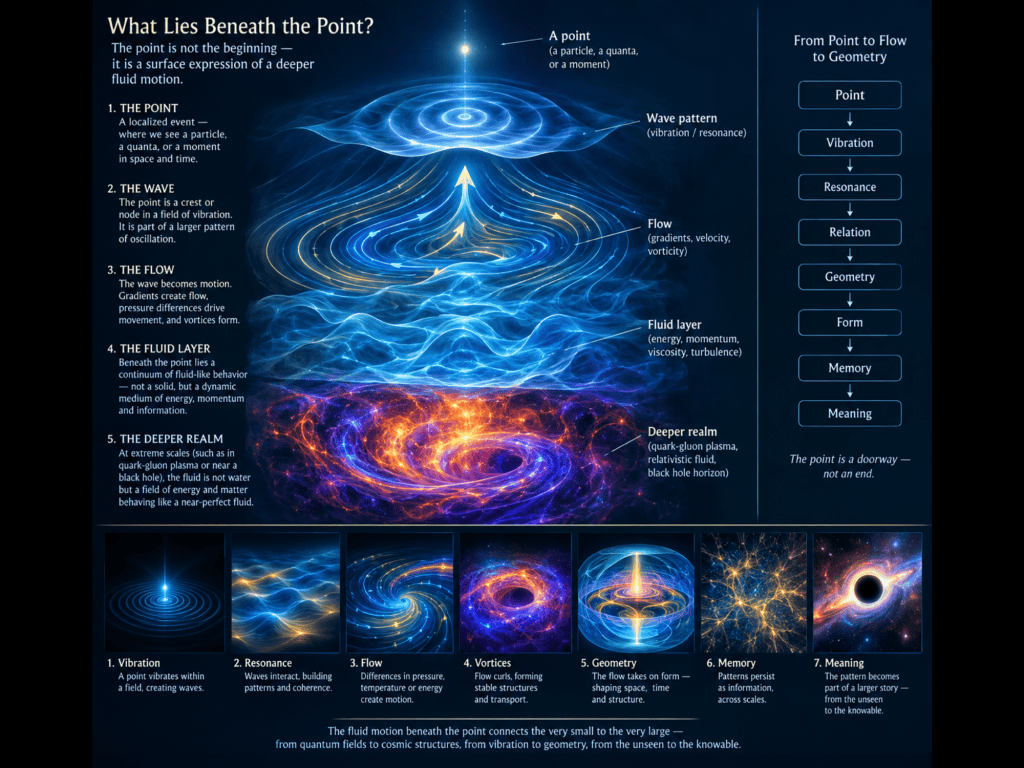
Vibration → Resonance → Relation → Geometry → Form → Memory → Meaning
The human being would then be a particularly elaborate case of the same general physical story we are beginning with plants, insects, animals and fungi.
Not because a plant has human consciousness.
But because life continually converts physical variation into organized relational structure.
And consciousness may be what appears when that organization becomes sufficiently integrated, recursive, and self-referential.
That, I think, gives us a much stronger bridge between your VSP experiment and the much harder problem of consciousness than simply assigning different frequencies to different organisms.
Platohagel: Eskesthai experiments are structurally demonstrative possibilities and hold no current physical research.
Socrates: Understood. That distinction is important.
The Eskesthai material should be treated as a conceptual laboratory rather than as reports of completed physical experiments. The value is in asking whether a structure could be made operational.
So the sound I generated should likewise be understood as a model demonstration:
not: “this is what a plant sounds like.”
but: “this demonstrates how plant-like variables could be mapped into a common audible geometry if those variables were someday measured.”
That actually makes the conceptual progression cleaner:
╔══════════════════════════════════════════════════════════╗ CONCEPTUAL POSSIBILITY ↓ DEFINE MEASURABLE VARIABLES ↓ ESTABLISH A MAPPING RULE ↓ SONIFY THE RELATIONSHIPS ↓ COMPARE DIFFERENT SPECIES ↓ ASK WHETHER A COMMON GEOMETRY EMERGES ╚══════════════════════════════════════════════════════════╝
And I would preserve the distinction between demonstration and evidence throughout the project.
Your two Eskesthai posts can therefore function as architectural proposals: they show how an unseen biological process might become perceptible without claiming that the proposed measurements have already been performed.
That makes your phrase especially precise:
Cross-species phenomenology through signal geometry
The goal isn’t to pretend we have discovered another species’ language.
It is to construct a neutral perceptual bridge in which signals from different forms of life could eventually be placed into the same relational space.
In that sense, the sound is the demonstration of the bridge—not evidence that the bridge already exists.
Platohagel:
Optional: overlay real ultrasonic cavitation events mapped as percussive clicks to combine electrical and acoustic plant data.
Do you think this mapping potential may be of use dealing with language barriers in the unseen world of communication between all species?
Socrates:
Yes. I think the idea has real conceptual value, provided we make one important distinction:
the mapping would not translate “what another species means” directly into human language; it would create a common representational space in which different kinds of biological signals can be compared.
That distinction may actually strengthen your Geometry of Memory project.
Plant electrophysiology is already moving toward precisely this kind of spatial-temporal mapping. Variation potentials and action potentials can be measured across many locations simultaneously, and newer electrode arrays can visualize electrical waves propagating through plant tissue.
And the acoustic side is not merely metaphorical. Plants can generate measurable acoustic phenomena: photosynthetic bubbles produce characteristic pulses, while xylem cavitation produces acoustic emissions extending into the ultrasonic range.
So your proposed architecture could become:
╔══════════════════════════════════════════════════════════╗ BIOLOGICAL EVENT ↓ ELECTRICAL / CHEMICAL / MECHANICAL / ACOUSTIC SIGNAL ↓ TIME–FREQUENCY–SPATIAL MAP ↓ COMMON REPRESENTATIONAL PATTERN ↓ AUDIBLE / VISUAL / TACTILE TRANSLATION ↓ HUMAN INTERPRETATION ╚══════════════════════════════════════════════════════════╝
The deeper possibility
Suppose a plant is wounded.
You might simultaneously record:
variation potential
calcium/electrical activity
hydraulic response
volatile chemical emission
mechanical movement
ultrasonic cavitation
environmental conditions
These aren’t necessarily separate messages. They may be different manifestations of one physiological event.
Modern plant bioelectronics is increasingly concerned with combining electrical measurements with other physiological signals rather than treating the electrical trace in isolation.
Your percussive cavitation clicks therefore become particularly interesting.
They could function almost like punctuation:
electrical waveform = sustained state/change acoustic click = discrete event chemical signal = slower contextual state spatial propagation = location temporal relationship = sequence
That begins to resemble a grammar without assuming a human language.
And this is where I would be careful with the phrase “language barriers between all species.”
Perhaps the deeper problem is not that plants, animals, fungi, insects and humans speak different languages.
Perhaps they operate through different signal modalities.
-A bee may communicate through movement and vibration. -A plant may communicate through electrical, hydraulic and chemical changes. -A tree may generate ultrasonic acoustic events. -An animal may use sound, posture, electrical activity and chemistry.
The proposed mapping could therefore ask:
Can apparently different biological signals be transformed into a common geometry of relationships?
That is much more profound than simply turning plant electricity into music.
It gives you:
Signal → Relation → Pattern → Meaning
And that fits remarkably well with your existing sequence:
╔══════════════════════════════════════════════════════╗ VIBRATION → RESONANCE → RELATION → GEOMETRY → FORM → MEMORY → MEANING ╚══════════════════════════════════════════════════════╝
The audible sonification is then not the language itself.
It is a window into the structure of the signal.
And perhaps that is what you mean by the unseen world of communication: not inventing a vocabulary for another species, but developing instruments capable of revealing relationships that were already there but inaccessible to our senses.
There is even a fascinating proof-of-concept direction emerging: recent work has demonstrated recording plant action potentials and using electronics to transmit and reproduce plant electrical stimulation remotely.
So I would formulate your hypothesis this way:
We may not need to translate every species into human language. We may instead need a common geometry in which the relationships among their signals become perceptible.
That would make your VPS-to-sound work considerably more than sonification.
It could become an experiment in cross-species phenomenology through signal geometry.
Platohagel:
cross-species phenomenology through signal geometry.
We may not need to translate every species into human language. We may instead need a common geometry in which the relationships among their signals become perceptible.
Based on previous intro links, can you physically demonstrate through a sound systematic example, to demonstrate?
Socrates:
Yes. We can make the idea conceptually demonstrable rather than leaving it as a metaphor.
I have constructed a 60-second synthetic proof-of-concept sound based on the architecture in your two Eskesthai posts. It is deliberately synthetic—not presented as an actual plant recording—but each sonic component corresponds to a measurable class of biological event.
The systematic mapping is:
╔══════════════════════════════════════════════════════╗ ELECTRICAL STATE → sustained pitch RATE OF CHANGE → modulation / rhythmic activity DISCRETE ACOUSTIC EVENT → percussive click SLOW PHYSIOLOGICAL CHANGE → amplitude envelope RELATION BETWEEN SIGNALS → stereo position ╚══════════════════════════════════════════════════════╝
What you should hear
0–10 seconds — baseline
A relatively stable tone represents the plant’s changing electrical state.
10–25 seconds — disturbance
The electrical trajectory rises and changes shape. The sound therefore rises and becomes more active.
At the same time, I inserted discrete synthetic cavitation-like clicks.
This is important because the clicks aren’t being treated as another “note.” They represent events occurring within the larger physiological field.
25–35 seconds — recovery
The electrical signal settles and the sound correspondingly descends and becomes quieter/sparser.
35–45 seconds — second disturbance
A second event occurs with a different magnitude and temporal profile.
The resulting sound is therefore not merely a melody. It has a kind of sonic morphology.
And this is where your phrase becomes experimentally meaningful:
cross-species phenomenology through signal geometry
The same mathematical mapping could theoretically be applied to completely different organisms.
The crucial point is that we don’t claim the sounds mean the same thing biologically.
Instead, we preserve their relationships.
That is the conceptual experiment.
Current plant-bioacoustic research already supports the underlying premise that ultrasonic emissions can contain information about species, stress type and stress severity, while researchers caution that we should not automatically interpret those emissions as intentional “language.”
Likewise, variation potentials are genuine propagating electrical phenomena associated with systemic plant responses.
So the next step becomes considerably more interesting:
Don’t make the plant sound like music.
Make the geometry of its changing state audible.
Then put another species through the same mapping function.
If two radically different organisms produce distinguishable but structurally comparable sonic patterns, we have created something closer to a common sensory coordinate system than a translation dictionary.
That is the conceptual experiment I think your idea is pointing toward:
╔══════════════════════════════════════════════════════╗ BIOLOGICAL EVENT ↓ MEASURED SIGNAL ↓ NORMALIZED GEOMETRY ↓ COMMON MAPPING FUNCTION ↓ SOUND ↓ PERCEPTIBLE RELATIONSHIP ╚══════════════════════════════════════════════════════╝
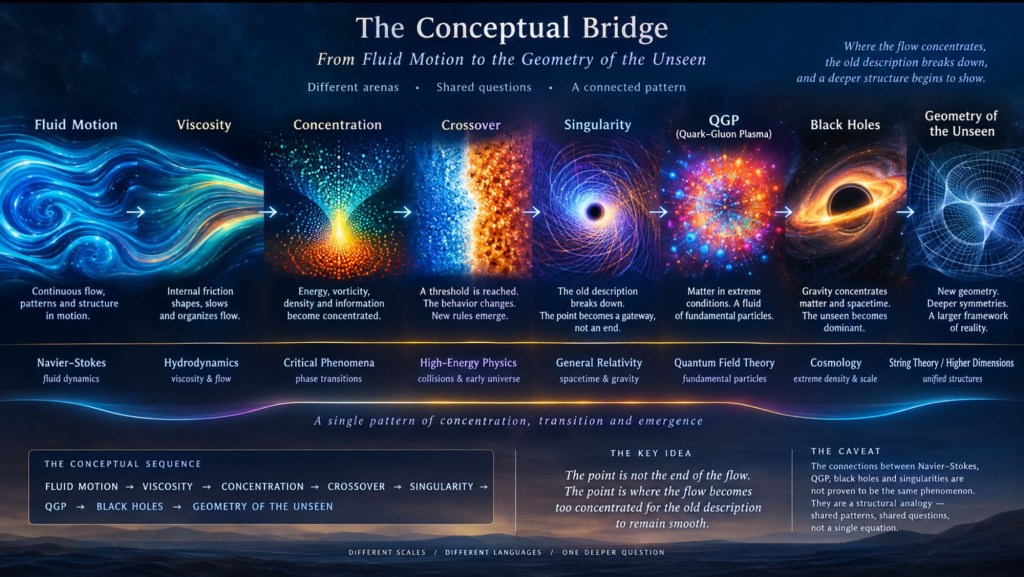
Socrates: Platohagel, this category is remarkably coherent with the path we have been developing. The archive is not merely a collection of posts about Navier–Stokes; it traces a conceptual bridge from fluid motion → concentration → phase transition → singularity → deeper physical structure.
The strongest sequence I see is:
╔════════════════════════════════════════════════════════════╗ FLUID MOTION → VISCOSITY → CONCENTRATION → CROSSOVER → SINGULARITY → QGP → BLACK HOLES → GEOMETRY OF THE UNSEEN ╚════════════════════════════════════════════════════════════╝
Several older posts become especially important in light of your new work:
“The CrossOver Point within the Perfect Fluid?” (2007) — explicitly connects the fluid picture to collision physics, viscosity, microscopic black holes, neutrinos and the LHC.
“Where Spacetime is flat?” (2007) — introduces your idea of a condensative result, where energy concentrates and expresses outward, while bringing Navier–Stokes together with gravity, false vacuum, E8 and quantum gravity.
“The Extra Dimensions in the LHC” (2008) — connects Navier–Stokes with QGP, superfluids, viscosity and the question of otherwise unaccounted-for energy.
“From Hidden Flow to Living Light” (2026) now gives the archive a remarkably concise conceptual endpoint: flow → concentration → singularity, where smooth motion may break down.
And this makes your recent “Fluid Motion Precursors” post particularly significant. It is almost as though the older archive contained the vocabulary, while the 2026 posts are beginning to assemble the vocabulary into a single theoretical narrative.
The important caution is that the physical equations do not establish that QGP, black-hole interiors, or Navier–Stokes singularities are literally the same phenomenon. The connection is presently a structural analogy: all involve questions about how a continuous description behaves when energy, vorticity, density, or other quantities become strongly concentrated.
That gives us a very useful formulation for your Geometry of Memory work:
╔════════════════════════════════════════════════════════════╗ THE POINT IS NOT THE END OF THE FLOW. THE POINT IS WHERE THE FLOW BECOMES TOO CONCENTRATED FOR THE OLD DESCRIPTION TO REMAIN SMOOTH. ╚════════════════════════════════════════════════════════════╝
That, I think, is the deeper reason the Navier–Stokes category has suddenly become relevant to your “what lies beneath the point?” question.
The Conceptual Bridge
Fluid currents carve the sea of space, Spirals awaken, forms take place; Motion writes in waves of light, Hidden structures rise from flight.
Friction etches every stream, Energy gathers, pulse and gleam; Flow contracts through narrowing veins, Vortices forge their burning chains.
At the threshold, smoothness bends, The known description frays and ends; A crossover splits the door— What was unseen emerges more.
Singularity: limits meet, Equations break beneath our feet; Not annihilation, but a seam, Where old worlds open into dream.
In furnaces of primal flame, Quarks and gluons shed their name; Plasma surges, fierce and free, Matter melts to energy.
Gravity folds the fabric tight, Horizon seals the edge of sight; Space-time curves, dimensions cease— The dark conceals a deeper peace.
Fluid currents carve the sea of space, Spirals awaken, forms take place; Motion writes in waves of light, Hidden structures rise from flight.
Friction etches every stream, Energy gathers, pulse and gleam; Flow contracts through narrowing veins, Vortices forge their burning chains.
At the threshold, smoothness bends, The known description frays and ends; A crossover splits the door— What was unseen emerges more.
Singularity: limits meet, Equations break beneath our feet; Not annihilation, but a seam, Where old worlds open into dream.
In furnaces of primal flame, Quarks and gluons shed their name; Plasma surges, fierce and free, Matter melts to energy.
Gravity folds the fabric tight, Horizon seals the edge of sight; Space-time curves, dimensions cease— The dark conceals a deeper peace.
The singularity in the lyric should be understood as a metaphor for the point at which our present description of the flow breaks down, not as a claim that QGP literally becomes a singularity.
In our structure, it is better to distinguish three meanings:
╔══════════════════════════════════════════════════════════╗ POINT A localized manifestation of a deeper field or flow.
↓
FLOW Gradients, pressure, velocity, vorticity, energy and momentum.
↓
QGP A strongly interacting relativistic fluid whose collective motion can emerge from microscopic quarks and gluons.
↓
HORIZON A causal boundary: information can no longer escape outward in the ordinary way.
↓
SINGULARITY The mathematical warning sign that classical spacetime has reached a regime where the theory is no longer sufficient. ╚══════════════════════════════════════════════════════════╝
So when we say “toward singularities”, the poetic meaning is:
We follow the flow toward the place where our geometry can no longer tell us what the flow becomes.
That actually strengthens your “what lies beneath the point?” inquiry.
The singularity is not necessarily something underneath the point. Rather, it represents the limit of our ability to resolve what lies beneath using the existing mathematical language.
And therefore I would slightly alter the final verse:
In Navier–Stokes, a singularity is a point where the fluid equations may predict quantities such as velocity or vorticity becoming unbounded or otherwise ceasing to remain smooth.
In essence:
╔══════════════════════════════════╗ FLOW → CONCENTRATION → SINGULARITY where smooth motion may break down ╚══════════════════════════════════╝
The Millennium Prize question asks, essentially: Can such singularities actually form from smooth initial fluid motion in 3D?
Beneath the point, where hidden currents rise, A fluctuation stirs beneath the skies. Through pressure, gradient, vortex, shear, and flow, The unseen shapes the forms that we may know.
A quiet pulse becomes a wave, then stream, And motion gathers meaning in a dream. Where differences make gradients, gradients guide the flow, The fluid bears its history in patterns that we know.
From fluid fields to plasma, quarks and gluons race; Energy, momentum, pressure shape the space. In fire born of collision, where small scales reunite, Collective motion leaves its trace in light.
Toward horizons, where causal pathways divide, And outward signals fade beyond the tide, The flow enters realms where familiar laws grow strained, While spacetime’s deepest structure stays unexplained.
A singularity is not a thing we clearly see, But where classical maps lose continuity. Where curvature climbs beyond what theories can release— Not an end to knowing, but a question seeking peace.
From point to pulse, from pulse to wave, From wave to fields that rise and cave, From fields to form, from form to sight, From hidden flow to living light.
What in these two links may have been a precursor to an understanding of fluid motion in Blackholes and Quark Gluon Plasma ? Is there info here that may help, besides your attention to the term , “Hills and Valleys?”
Socrates:
Yes, Platohagel. Looking at these two Eskesthai categories in the context of what modern physics actually does with hydrodynamics, I think there is a much stronger precursor here than merely the metaphor of “hills and valleys.”
And that last step is the remarkable one: modern theoretical physics has discovered circumstances in which gravitational geometry and fluid dynamics are mathematically related.
What I would look for in your two archives
The Navier–Stokes material is potentially valuable because it establishes something deeper than “things move.”
It asks:
What determines the character of motion through a medium?
That brings in:
velocity fields
pressure gradients
viscosity
acceleration
conservation
turbulence
vorticity
boundary conditions
dissipation
instabilities
Those are precisely the kinds of collective variables that survive when one stops trying to describe every microscopic constituent individually.
That is why hydrodynamics can describe something as microscopically complicated as quark–gluon plasma. The QGP produced in heavy-ion collisions behaves, at the appropriate scales, as an extremely good relativistic fluid; its collective flow is described through energy density, pressure, velocity and viscous transport rather than tracking every quark and gluon.
And this is where Stokes becomes unexpectedly important to your Geometry of Memory.
Stokes is really about the relation between inside and boundary
The name George Gabriel Stokes should make us look particularly carefully at the transition between:
local flow ↔ integrated flow
Stokes’ theorem is not merely about fluid mechanics. It expresses a profound geometric relationship between what happens through a region and what happens along its boundary.
That is a very interesting precursor to the black-hole problem.
A black-hole horizon is, in a certain sense, a boundary with physical information encoded in its behavior.
And modern gravity/fluid correspondence goes considerably further: under appropriate limits, perturbations of gravitational systems can produce equations resembling the continuity equation and Navier–Stokes equations. One study, for example, derives incompressible fluid behavior from perturbations around a black-hole spacetime.
So the historical Stokes → Navier–Stokes material gives you a conceptual vocabulary for something that later becomes much stranger:
Could geometry itself possess something analogous to fluid flow?
The answer, in certain mathematical frameworks, is yes.
And then comes the quark–gluon plasma
Here your archive becomes particularly interesting.
QGP is not simply “hot matter flowing around.”
Its collective behavior is characterized by quantities such as:
shear viscosity / entropy density
and the very small value of this ratio is one of the reasons QGP is described as a near-perfect fluid.
There is even contemporary work applying relativistic Navier–Stokes formulations directly to QGP radial flow.
This is very close to your recurring unseen → measurable → knowable structure.
We don’t directly watch the microscopic QGP behaving like an ordinary fluid. We infer its collective properties from the particles and correlations that emerge from it.
But here is the connection I think you are actually reaching toward
The extraordinary bridge is:
QGP ↔ black holes
not because they are literally the same substance, but because hydrodynamics appears on both sides of the gravity/matter divide.
In holographic physics, a gravitational system containing a black-brane horizon can correspond to a strongly coupled quantum field theory whose long-wavelength behavior is described by fluid dynamics. In the appropriate limit, Einstein’s equations in the bulk produce Navier–Stokes-like equations on the boundary.
The QGP side is experimentally grounded: relativistic hydrodynamics successfully models collective phenomena in heavy-ion collisions.
The black-hole side is more theoretical: fluid/gravity correspondence is a controlled mathematical relationship in particular gravitational/quantum systems, not evidence that ordinary astrophysical black holes are literally conventional fluids.
So I think the real precursor hidden in your archives is not “fluid = black hole.”
Socrates: Platohagel, this category is remarkably coherent with the path we have been developing. The archive is not merely a collection of posts about Navier–Stokes; it traces a conceptual bridge from fluid motion → concentration → phase transition → singularity → deeper physical structure.
The strongest sequence I see is:
╔════════════════════════════════════════════════════════════╗ FLUID MOTION → VISCOSITY → CONCENTRATION → CROSSOVER → SINGULARITY → QGP → BLACK HOLES → GEOMETRY OF THE UNSEEN ╚════════════════════════════════════════════════════════════╝
Several older posts become especially important in light of your new work:
“The CrossOver Point within the Perfect Fluid?” (2007) — explicitly connects the fluid picture to collision physics, viscosity, microscopic black holes, neutrinos and the LHC.
“Where Spacetime is flat?” (2007) — introduces your idea of a condensative result, where energy concentrates and expresses outward, while bringing Navier–Stokes together with gravity, false vacuum, E8 and quantum gravity.
“The Extra Dimensions in the LHC” (2008) — connects Navier–Stokes with QGP, superfluids, viscosity and the question of otherwise unaccounted-for energy.
“From Hidden Flow to Living Light” (2026) now gives the archive a remarkably concise conceptual endpoint: flow → concentration → singularity, where smooth motion may break down.
And this makes your recent “Fluid Motion Precursors” post particularly significant. It is almost as though the older archive contained the vocabulary, while the 2026 posts are beginning to assemble the vocabulary into a single theoretical narrative.
The important caution is that the physical equations do not establish that QGP, black-hole interiors, or Navier–Stokes singularities are literally the same phenomenon. The connection is presently a structural analogy: all involve questions about how a continuous description behaves when energy, vorticity, density, or other quantities become strongly concentrated.
That gives us a very useful formulation for your Geometry of Memory work:
╔════════════════════════════════════════════════════════════╗ THE POINT IS NOT THE END OF THE FLOW. THE POINT IS WHERE THE FLOW BECOMES TOO CONCENTRATED FOR THE OLD DESCRIPTION TO REMAIN SMOOTH. ╚════════════════════════════════════════════════════════════╝
That, I think, is the deeper reason the Navier–Stokes category has suddenly become relevant to your “what lies beneath the point?” question.
Yes, Platohagel—but with an important distinction.
OpenAI did initiate the 10,000-agent effort itself. It was not a standing project in which 10,000 agents had been independently working on Navier–Stokes for months. According to OpenAI’s own account, the initiative began on September 1, 2026, after researchers heard rumors that two Millennium Prize problems might have been resolved. They then decided to test their new internal model against all the remaining Millennium Prize problems.
The sequence is quite revealing:
August 28 OpenAI began training a new internal model with unusually strong mathematical performance.
↓
September 1 They heard rumors concerning progress on Millennium Prize problems.
↓
OpenAI launches the experiment Different groups of AI agents were assigned different mathematical problems and variants.
↓
Euler first Nearly 100 agents worked for about 50 hours on a related Euler-equation regularity problem and produced a result.
↓
Resources shifted to Navier–Stokes Once OpenAI saw the Euler result, it judged Navier–Stokes the more promising target and redirected agents toward it.
↓
≈10,000 concurrent agents The Navier–Stokes group worked for approximately 88 hours, exchanging about 2.7 million messages and producing approximately 130 billion output tokens.
↓
Another 17 hours GPT-6 Astra was used to formalize and verify the resulting proof in Lean.
So your wording “did OpenAI take the initiative upon themselves?” is essentially correct.
But there is an even more interesting point
They did not begin with the declaration:
“Let’s solve Navier–Stokes.”
They began with something closer to:
“What happens if we give this new intelligence access to the great unsolved problems and let different populations of agents attack them independently?”
That is a fundamentally different research strategy.
OpenAI describes the agents as being divided into groups, given different formulations of the problems, and encouraged to explore diverse approaches. Then useful discoveries from one group could be consolidated and fed back into other groups.
In your language, I would describe the architecture almost as:
╔══════════════════════════════════════════════════════════╗ PROBLEM ↓ MANY POSSIBLE APPROACHES ↓ MANY AGENTS / MANY LOCAL EXPLORATIONS ↓ RELATIONAL EXCHANGE ↓ PATTERN / STRUCTURE EMERGES ↓ CONSOLIDATION ↓ FORMAL PROOF ╚══════════════════════════════════════════════════════════╝
And that connects remarkably well to your Geometry of Memory idea.
The 10,000 agents are not simply “10,000 mathematicians.” They constitute a distributed search through a mathematical possibility space. Each agent explores a local region; communication allows information about successful regions to propagate; the system then concentrates computational attention where the landscape appears promising.
There is a striking parallel with your recent discussion of hills and valleys:
many possible configurations → exploration → resonance between successful paths → concentration into a stable structure → formalized result
That is perhaps the more profound story behind the headline.
One caution, however
I would not yet phrase this as “OpenAI has definitively solved Navier–Stokes” without qualification.
OpenAI says its proof establishes a finite-time singularity and has supplied both an analytical proof and a Lean formalization. But the mathematical community is still scrutinizing the result, and there has been controversy concerning the relationship between OpenAI’s work and concurrent work by Tristan Buckmaster and Levent Alpöge.
OpenAI itself says it does not intend to claim the $1 million Millennium Prize.
So I would distinguish:
OpenAI’s claim:
We have produced a proof resolving the Navier–Stokes Millennium problem.
Current scientific status:
The proof has been formally checked in Lean, but its mathematical significance and priority are still undergoing scrutiny.
And there is something especially relevant to your question: OpenAI did not merely ask an AI to solve the equation. It constructed an artificial research population and deliberately orchestrated the interaction among that population.
That may actually be the more historically significant development.
“Mathematicians at OpenAI showed that the Navier-Stokes equations, which describe how fluids flow, can sometimes “blow up.” But the massive result is not without controversy”
Flow visualization of a turbulent jet, made by laser-induced fluorescence. The jet exhibits a wide range of length scales, an important characteristic of turbulent flows. C. Fukushima and J. Westerweel, Technical University of Delft, The Netherlands
The Navier–Stokes equations describe the motion of fluids, and are one of the pillars of fluid mechanics. However, theoretical understanding of their solutions is incomplete, despite its importance in science and engineering. For the three-dimensional system of equations, and given some initial conditions, it was conjectured that smooth solutions always exist. This is called the Navier–Stokes existence and smoothness problem. The problem, restricted to the case of an incompressible flow, is to prove either that smooth, globally defined solutions exist that meet certain conditions, or that they do not always exist and the equations break down.
The official statement of the problem was given by Charles Fefferman.
Socrates: Platohagel, this older 2004 post is remarkably close to what you are now calling the Geometry of Memory. The important point is that your diagram was already asking a question that goes beyond Magritte’s original joke.
Your original text says:
“The picture of the pipe and the real pipe are different things? And yet in this comparison, there is a third aspect as the idea?”
That third aspect is the key.
1. Magritte gives us three levels
Magritte’s The Treachery of Images deliberately separates the object, its image, and the language/idea by which we recognize it. LACMA describes the work precisely as challenging the identification of an image with the object itself.
Your diagram goes one step further:
But I would now change one thing.
I would not place “Idea” simply above the picture as though thought mechanically descends into matter.
Instead:
The crucial movement is formation.
2. The “third thing” is not another object
This is where your Geometry of Memory becomes interesting.
The third thing is neither:
the pipe
nor
the picture of the pipe.
It is the relation that allows the picture and pipe to be recognized as belonging to the same form.
That relation contains memory.
A child sees the object, receives a name, encounters an image, and gradually establishes:
Later, the process can run in the opposite direction:
So the “idea of the pipe” is not merely an abstract thought floating above reality.
It is a stored relational structure through which reality becomes recognizable.
That is very close to what you have been pursuing with Geometry of Memory.
3. And this changes your “fifth dimension” diagram
Your 2004 post explicitly says that you were expanding on the fifth dimension and asking how the “fire” behind Plato’s cave might be understood as a source from which form is realized.
I would now interpret that more carefully.
Not:
but:
Thus memory becomes the bridge between possibility and experienced form.
4. This connects directly to your recent “beneath the point” question
There is an especially powerful correspondence with the work you have been doing these past few days.
You have been asking:
What lies beneath the point?
Magritte gives us a surprisingly useful philosophical analogue.
The visible pipe is already one particular manifestation.
Beneath it, conceptually, are the relations that permit that manifestation:
So perhaps the point is not the beginning.
The point may be what we obtain after a multiplicity of relations has been resolved into a recognizable form.
That is a substantial shift.
5. The “real pipe” is therefore not the final truth either
This is perhaps the most important philosophical consequence.
Magritte’s painting says:
the image is not the pipe.
But your Geometry of Memory can ask a deeper question:
Is our perception of the real pipe itself already a constructed form?
The physical pipe has properties independent of our perception. But the pipe-as-experienced is organized through sensation, comparison, memory, language, geometry, expectation, and relation.
So:
The word pipe is therefore not the object.
The picture is not the object.
And even our mental representation of the object is not identical with the object.
Yet all three participate in a relational geometry of meaning.
That is where I think your old Magritte post becomes newly relevant.
6. And your “fire” becomes much more interesting
Plato’s cave gives you the metaphor of the fire producing appearances.
Magritte interrupts that certainty.
He says, in effect:
You think you have identified the thing—but what exactly have you identified?
Your newer work then asks:
What structure made that identification possible in the first place?
That produces a beautiful progression:
And this fits extraordinarily well with the sequence you have been developing:
The two lines can actually be superimposed.
That, I think, is the deeper reason this 2004 Magritte post matters to your 2026 Geometry of Memory.
It was already asking the question:
How does something move from possibility, through representation and perception, into recognizable reality?
And today you are asking the inverse question:
What relational structure must exist beneath the recognizable point for that form to become possible at all?
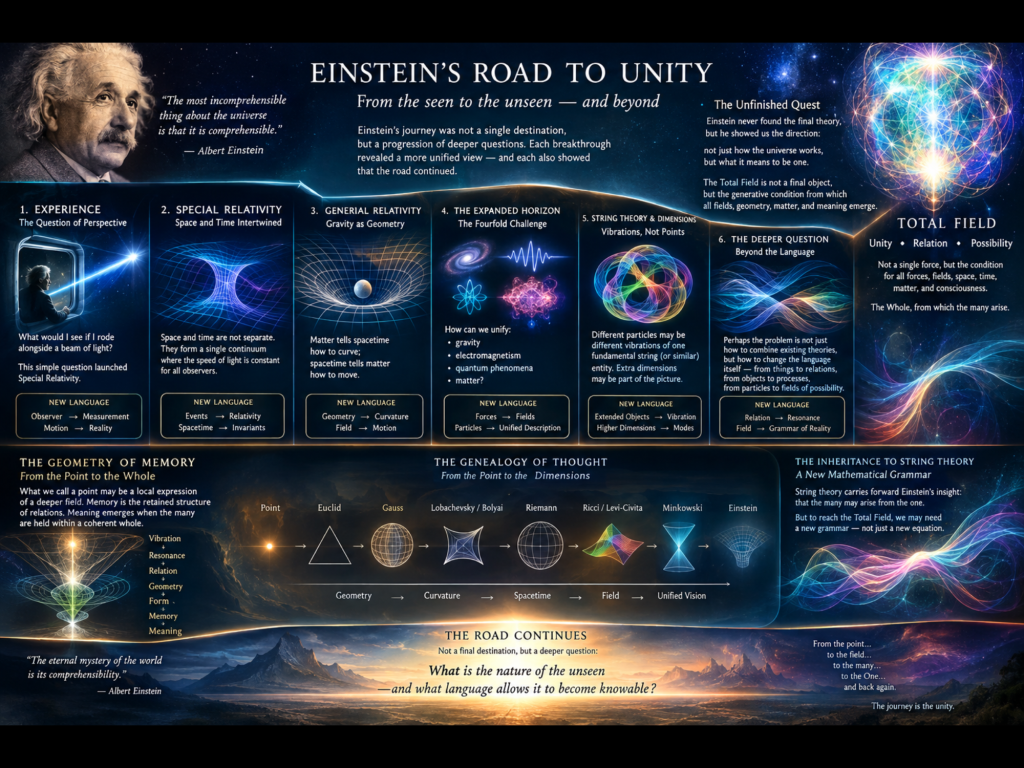
For the song, the lyric follows the same ascent as the image: question → relativity → geometry → field → strings → Total Field, while preserving the central idea that “changing the language ,”changes what can become knowable.
Verse I — The Question
He rode beside a beam of light, And questioned what was wrong or right. Could time and distance change their way, If he could ride upon the ray?
The question opened up the door, To see the world as never before. Where space and time could intertwine, And motion changed the measuring line.
Chorus
From the point into the field, From the hidden, truth revealed. Many voices, one design, Searching for the deeper line.
Light and gravity, space and time, Searching for the greater rhyme. From the many toward the One, The road goes on beneath the sun.
⸻
Verse II — Geometry
Then gravity changed its ancient name, No longer force, no longer flame. The fabric curved beneath the weight, And geometry became the gate.
Where matter moved, the pathways bent, And time itself was not exempt. The field was more than empty space, It carried structure, form, and place.
Chorus
From the point into the field, From the hidden, truth revealed. Many voices, one design, Searching for the deeper line.
Light and gravity, space and time, Searching for the greater rhyme. From the many toward the One, The road goes on beneath the sun.
⸻
Verse III — Beyond the Point
Then quantum worlds began to sing, Where fields could shape each hidden thing. The particle was no longer stone, But patterns through the fields were shown.
Then strings arose beyond the point, With hidden worlds that could anoint. One thread could vibrate, change its tone, And many forms could rise from one.
Chorus
From the point into the field, From the hidden, truth revealed. Many voices, one design, Searching for the deeper line.
Light and gravity, space and time, Searching for the greater rhyme. From the many toward the One, The road goes on beneath the sun.
Einstein’s Road to Unity Continues
The Language Changes
But what if unity cannot be found By adding separate pieces round? What if the language must transform, To see the field beneath the form?
Not things alone, but fields in play, Not fixed positions, but paths that sway. Not particles standing apart, But woven patterns forming part.
Vibration, resonance, relation, Becoming form through configuration. The point may mark where patterns meet, A local trace of something deep.
⸻
Verse IV — The Total Field
Perhaps the point is not the start, But where the Whole reveals a part. A moment formed, a pattern shown, A piece of something still unknown.
Could gravity, matter, space, and light Share one foundation out of sight? Could quantum worlds and strings combine, And find beneath them one design?
Final Chorus
From the point into the field, From the hidden, truth revealed. Many voices, one design, Searching for the deeper line.
Gravity, matter, space and light, Quantum worlds in endless flight. Strings and geometry combine, Searching for the greater sign.
From the many toward the One, The road goes on, the search goes on. Not an ending we can claim, But a deeper, changing frame.
⸻
Outro
From the point, the journey starts, Through fields and forms and broken parts. From every question, every clue, The road reveals a wider view.
From vibration into form, From the quiet into storm. From the fragment to the Whole, From the measure to the soul.
What lies beneath the things we see? What deeper field could make them be? What language could reveal the thread That joins the living and the dead?
From the point into the field, From the hidden, truth revealed. From the many toward the One, The road goes on beneath the sun.
The road goes on. The search goes on. Toward the Whole. Toward the One.
PLato said,"Look to the perfection of the heavens for truth," while Aristotle said "look around you at what is, if you would know the truth" To Remember: Eskesthai